Melissa Evans
Content Writer, GroupTogether.
Can teachers accept gifts in Australia? Yes...but the answer gets a little more complicated once you start looking at the rules. From gift limits to gift cards and different state-by-state policies, here’s what parents need to know before the class starts passing around the collection tin.
By Melissa Evans
Last updated on

It’s a surprisingly tricky question to answer for something that usually starts with a, “Should we all just chuck in $10?” text in the WhatsApp chat. But it turns out, there are a few rules to look out for – so before the class accidentally turns a thoughtful gift into a compliance headache, here’s what parents need to know about teacher gift limits, eGift Cards and the rules in each state.
First up, there’s no single Australian teacher gift limit – rules for teachers in government schools are set through state and territory policies, and they can cover whether a gift can be accepted, whether it needs to be declared and whether a teacher can personally keep it.
If you're organising a teacher gift from the whole class, the safest approach is to check the policy that applies to your school rather than relying on a blanket dollar amount you may have heard elsewhere. Another must-note is that Catholic and independent schools may have their own policies, so all the more reason to check in with your school’s admin first.
Generally, teachers can accept gifts from students and parents, particularly small-value gifts of appreciation. But whether a particular gift needs to be declared depends on the state or territory, the value and nature of the gift and the school's own policy.
For example, Victoria has a specific $100 threshold for certain gifts of appreciation to government-school teaching staff, Queensland has a $150 declaration threshold – so there’s no one nationwide limit.
The common thread is that teachers shouldn’t be the ones to solicit gifts, and gifts shouldn’t create an actual or perceived conflict of interest or influence a teacher's professional decisions – for instance, a class gift isn’t a bribe for better marks!
It all comes down to the simple fact that education across the board – not just when it comes to gifts – is administered by individual states and territories, so government-based school employees are subject to the relevant jurisdiction's public sector and education policies.
The policies also distinguish between three aspects: Accepting a gift, declaring a gift and being allowed to personally keep a gift. That's why you'll see different figures mentioned online – a $100 or $150 threshold might mean that a gift must be declared above that value – not that gifts below that amount are automatically permitted, or that gifts above it are automatically prohibited.
The nature of the gift matters too. Cash, cash-equivalent eGift Cards, gifts from suppliers and anything that could be perceived as an inducement or bribe are treated much more cautiously than a small end-of-year gift from a family or class.
Take a look at some of the state specifics for government schools:
Yeah, it sounds a little complicated, but that’s why jumping straight to your school’s rules is often the easiest way to get the straight scoop.
Keen for the nitty gritty of the rules? We’ve got you – let’s unpack state by state.
For NSW public school employees, the Department of Education's current Gifts, Benefits and Hospitality procedure says employees must report gifts, benefits or hospitality valued at more than $50, regardless of the number of contributors. It also says employees cannot accept cash or cash equivalents, but specifically notes that store eGift Cards aren’t treated as universally accepted cash – a major plus for convenient class gifting!
That $50 figure is best understood as a reporting threshold, not a simple rule saying “teachers can't accept gifts over $50”. For parents organising a class gift, a modest gift is generally much less complicated than an expensive personal gift, so if you're planning something more substantial, ask the school or teacher what its procedure requires.
Victoria has one of the clearest distinctions between ordinary gifts and “gifts of appreciation” from students, parents and carers, making things a little easier than other states. For Victorian government school teaching staff, a gift of appreciation valued at $100 or less is considered a token gift and doesn’t need to be declared, but a gift of appreciation above $100 is considered non-token and must be declared. The total value of a group gift counts – parents can't treat each individual contribution as a separate $20 gift.
There are additional rules for gifts of appreciation worth $500 or more. Where the gift is offered by multiple students, an authorised delegate can allow the teacher to retain it, otherwise it must be declined or transferred to the school.
So if you're searching for the teacher gift limit Victoria figure, you'll often see $100 – just remember that it is the token threshold for a particular category of gift of appreciation, not a universal legal maximum.
Queensland's Department of Education has a current Gifts and Benefits Procedure that was set in motion just last year on the 7th of October.
It means that teachers and other department employees must seek approval to retain gifts, and gifts valued at more than $150 generally require a declaration. Gifts exceeding $350 receive heightened scrutiny and can only be retained in exceptional circumstances – basically, it’s best avoided for your class gift.
The procedure specifically recognises the tradition of students and parents giving teachers gifts at the end of the school year, allowing teachers to consider accepting a gift of gratitude or a gift offered by a student or parent, subject to the approval requirements.
Cash and items readily converted into cash, including Mastercard and Visa prepaid cards and vouchers that can be converted to cash, must be refused.
If you're organising a class gift in Queensland, it's worth keeping the total value in mind and asking the school if you're planning something above the usual small-token range.
Western Australia's Department of Education has detailed rules around Gifts of Appreciation, but we’ve got the rundown for you.
Where a Gift of Appreciation is worth more than $100, it can only be accepted if it’s provided by a group of students, parents or carers, and it must be declared.
For a gift worth $500 or more, the gift should either be declined or approved to be retained by the school rather than the individual teacher. Importantly for class collections, the value of the whole gift is what counts, rather than how much each individual family contributed.
WA's policy specifically distinguishes between cash vouchers and retailer-specific gift cards – a gift card that can only be used at a specific retailer and cannot be converted to cash may be accepted.
South Australia's approach is less about one fixed dollar amount and more about the nature and circumstances of the gift. The South Australian public-sector Gifts and Benefits Guideline says token gifts of inconsequential or trivial value may generally be accepted, provided they don't create a conflict of interest or reputational damage.
For a teacher appreciation gift, the sensible approach is to keep it modest and clearly about saying thank you, rather than giving something expensive or potentially creating a sense of obligation. Sometimes, less is more!
Tasmania takes a relatively conservative approach – The Department for Education, Children and Young People says that, with very few exceptions, only token mementos or modest refreshments can be accepted without prior approval or declaration. Non-token gifts should generally be politely declined or returned unless there are exceptional circumstances.
The department explicitly says that employees shouldn’t expect gifts for doing their jobs and suggests that a simple card, letter or email is an appropriate alternative.
For parents: If you're in Tasmania, a heartfelt card is the easy option, and with gorgeous group cards available today, it’ll be a hit.
The ACT Education Directorate's school-based staff Code of Conduct gives an example of a student giving a teacher a vase worth approximately $40 and describes keeping it as an appropriate response where the gift is considered nominal. It also says gifts above nominal value should generally be declared and transferred to the supervisor or principal.
The broader ACTPS Gifts, Benefits and Hospitality Policy also makes clear that directorates can establish their own value thresholds and approval arrangements.
The current guidance points towards modest, nominal appreciation gifts, rather than a solid limit, with larger gifts requiring additional consideration.
The NT Department of Education says that gifts of appreciation and gifts with no retail value from or on behalf of students, parents, guardians and carers are not considered a gift or benefit under its policy. But teachers still have to consider whether accepting a gift is appropriate and must not accept something where it could be perceived as influencing their duties.
Note: Cash and items readily convertible to cash cannot be accepted.
So, there’s not a hard limit, but if you're unsure, the department advises employees to seek guidance and follow the relevant approval process.
Here’s where things get a little complicated – the state and territory rules above are primarily about government and public school employees, while catholic schools and independent schools are separate employers and may have their own codes of conduct and gift policies.
Catholic education is organised through state and territory Catholic education bodies and systems, rather than one single national employer policy. Then you’ve got independent schools – these tend to have even more variation. Independent Schools Australia says that most independent schools are governed by their own school board or council and have their own policies and procedures for day-to-day school management.
So if your child attends a Catholic or independent school, don't automatically apply the government-school rule for your state. Check the school's own policy or ask the principal or administration team.
For example, a Catholic Education code in Queensland says staff may accept small gifts of thanks from parents, carers or students, while also warning that gifts can create conflicts of interest depending on the circumstances.
The verdict: With so much variance, the easiest solution is to ask your school.
Sometimes, but this is one area where the type of card matters – an eGift Card that functions like cash, such as a prepaid Visa or Mastercard, can be prohibited under public sector gift rules. A retailer-specific eGift Card can be treated differently.
For example:
If you've already started the class WhatsApp group and someone’s asked if teachers are even allowed to accept a gift, don't panic. Here’s how to answer their questions – and your own – in 5 easy steps.
Look on the school's website for its code of conduct, staff gifts policy or gifts and benefits policy. If you can't find one, ask the school office.
If you're organising a group gift, it's worth checking the rules before everyone contributes. This is especially important where the state's policy treats the total value of a group gift as the value of the gift received by the teacher.
A thoughtful card, flowers, chocolates, a small gift or flexible eGift Card is very different from an expensive personal gift.
A teacher gift should be voluntary. Families have different budgets and circumstances, and no child should feel uncomfortable because their family isn't contributing.
This is probably the most useful rule of all. The school can tell you whether a particular gift is permitted, whether there is a value threshold and whether the teacher needs to declare it. And if the answer is “a gift isn't appropriate”, a teacher card is still a standout way to say thank you.
After all, our 2026 teacher research found that the messages on cards are sometimes more moving than the gift, with one teacher sharing, ““I keep cards and the beautiful words from parents are never forgotten.”
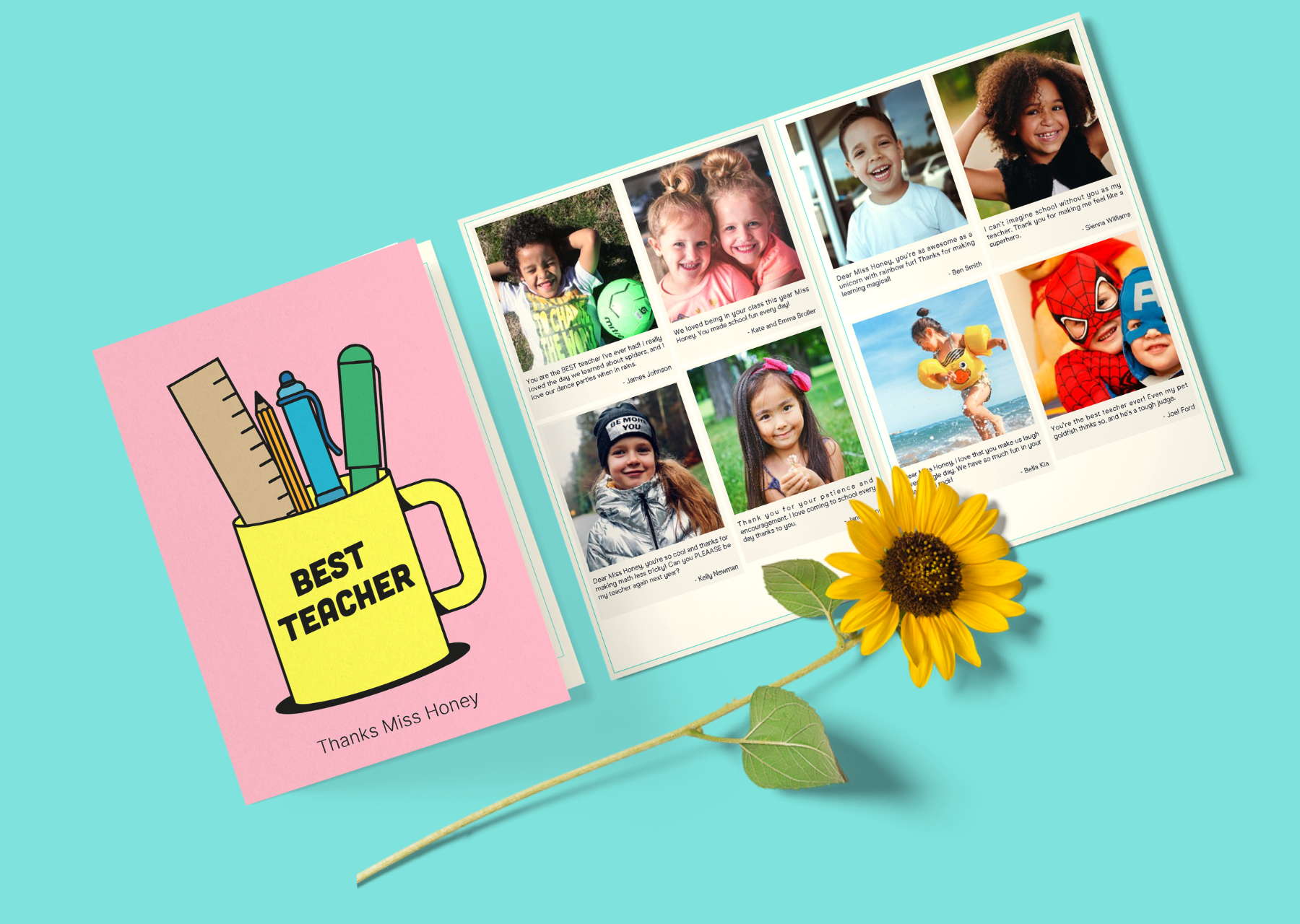
Not sure what to write in your teacher card? We’ve got a guide for that too.
You Ask, We Answer
Yes, teachers can accept some gifts from students or their families, but the rules vary between states, territories and school sectors. Small tokens of appreciation are generally treated differently from expensive gifts, cash or gifts that could create a conflict of interest.
There is no single teacher gift limit in Australia. Different jurisdictions use different thresholds for reporting, approval or retention, and those thresholds should not be confused with a universal maximum gift value.
It depends on the jurisdiction and the type of gift card. Retailer-specific gift cards may be permitted in some jurisdictions, while cash-equivalent prepaid cards can be prohibited. Check the school's policy before giving a gift card, particularly for a higher-value class gift.
Generally, group gifts can be given in jurisdictions that allow gifts of appreciation, but the total value of the gift may matter, rather than how much each individual family contributes.
Don't take it personally! It may simply be that the school's policy requires the gift to be declined, declared or transferred to the school. A thoughtful card or class message can still be a wonderful way to say thank you.

Melissa Evans
Content Writer, GroupTogether.

Ali + Julie
Co-Founders, GroupTogether
Life’s busy. That’s why we’re here to make it easy for you to collect money from a group. Less wasted time, less packaging waste, and spending a little less but giving a lot better!