Melissa Evans
Content Writer
Gifting Tips
So, how much is everyone actually putting towards the teacher gift? It's the question parents ruminate over when the class collection rolls around. We've got the answer, and it's not as complex as you think! Here's how much to contribute, what's considered reasonable and how to organize a thoughtful thank you without leaving anyone's wallet feel disconcertingly light.
By Melissa Evans
Last updated on

When the kids are counting down to the holidays and the teachers are eyeing up a well-earned break, you realize gifting season has come around the corner shockingly fast and you don’t have enough time to pull off a Christmas miracle. Luckily, there’s an easier way to get things up and running in a matter of minutes – and deciding on contributions doesn’t have to be an Olympic feat. Here’s how to simplify everything.
Parents are asking how much they should be paying on the group chat – is $10 enough? Is $20 too much? Should everyone contribute the same amount? And what happens if some families can’t contribute at all?
If you're organizing a teacher gift, you're probably wondering exactly the same things. The good news is there's no magic number, no official parent contribution quota and certainly no need to take out a small loan for a winning gift.
Here's what parents typically spend, what teachers actually prefer and how to organize a group teacher gift without putting anyone under the spotlight.
For a group teacher gift, 5-20 dollars per family is a reasonable optional contribution, with 10-20 dollars being a useful starting point for many class collections.
GroupTogether's own gifting data shows that parents contribute an average of $20 towards teacher gifts, and just remember that this is an average across GroupTogether collections, not a recommended minimum or an expectation for every family.
If you're buying an individual gift, there's no set amount either, though a small, thoughtful present or a handwritten card from your child is more than enough to show appreciation.
The most important thing is to keep contributions voluntary. Families have different budgets, and nobody should feel pressured to spend more than they're comfortable with.
If you're looking for a ballpark figure, you're certainly not alone. Teacher gift contributions are one of those things that can feel surprisingly difficult to navigate, especially when nobody wants to be the parent who suggests an amount that's wildly different from everyone else's.
So, there may not be a standard, but the following can be a good place to start:
These are just practical budgeting suggestions, rather than codified rules or expectations – the right amount will depend on the size of the class, the occasion, the gift you're planning and what families can comfortably afford.
It's also worth remembering that the total class gift can be quite substantial even when individual contributions are small – for example, if 20 families each contribute $10, that's $200 towards one lovely gift. If half the class contributes $20, that's another $200. A little really can go a long way when everyone pools together.
And if you're wondering whether teachers actually prefer one larger gift or lots of individual presents, we've got some interesting research on that.
In GroupTogether's 2026 teacher gift survey, we asked 140 teachers about their experiences receiving gifts from students and families – the results were pretty clear: 90.7% of teachers said they preferred receiving one group gift from the whole class rather than individual presents. Yep, that's 127 teachers out of 140 who have had it up to their ears with mugs and chocolates.
So it’s no wonder group gifts are the winner – and not just for teachers. A group gift allows families to pool their contributions rather than overspending, and lets them choose something more useful, rather than leaving a teacher with 20 versions of the same novelty present.
Teachers also revealed the importance of the messages that came with their gifts. One respondent shared that they loved receiving a gift card, but that the best part was all the messages from the children.
So, if you're deciding between a collection of individual presents and one class gift, the teachers have given you a pretty good answer – you can read the whole scoop in our 2026 Teacher Gift Survey.
Both individual and class gifts can be much-appreciated ways to thank a teacher, but they work a little differently.
An individual family gift is a nice option if your child has a particularly close relationship with their teacher – it could be a small bunch of flowers, a book, a favorite treat or a handwritten note. There's no need to spend a fortune to make it personal, even if you are going solo!
A whole-class gift, on the other hand, is an easier option when you want to bring everyone together and slash costs per person.
Rather than every family trying to guess what the teacher might like, you can pool the money and choose something a little more substantial. There are a few other benefits, too:
Given that 90.7% of teachers in our survey preferred a group gift, it's certainly worth considering!
If you're the parent organizing the collection, suggesting an amount can make things much easier.
Rather than leaving everyone wondering what to give, a suggested contribution of 10-20 per family is a reasonable place to start for many class collections. Of course, you can adjust this depending on the number of families involved and the type of gift you're planning, along with a few other things to consider when choosing your suggested amount:
One of the easiest ways to approach it is to choose a modest suggested amount, make it clear that it's optional and let families decide what works for them. Parents are happy, students are happy and teachers are happy – it’s your classic Michael Scott win-win-win method of problem solving!
There are all sorts of reasons a family might not contribute – they could be managing a tight budget, have multiple children at the school, prefer to give their own gift or have other priorities at the moment. And that's cool!
If you’re a type A organizer, we know it’s hard to accept it, but there’s a solid reason why accounting for these cases is part of a good plan: A teacher gift should be a gesture of appreciation, not another school-related expense families feel obliged to pay.
Here are a few simple etiquette tips to keep things comfortable for everyone:
Daycare and preschool gifts can be a little different from primary school teacher gifts – rather than one class teacher, your child might have several educators who care for them throughout the week. There might be a room leader, assistant educators, float staff and even a center director who all play a part in their day.
While they might make a great team, the sheer numbers can turn that one little gift into a collection for half the center! But don’t worry, the same general principle applies; there's no set amount, and a small optional contribution from each family is perfectly reasonable.
If you're organizing a group gift, consider:
The educator who remembers exactly how your child likes their sandwiches cut and has mastered the art of getting a room of toddlers to sit down at once probably deserves a very big thank you.
eGift Cards are a popular choice for teacher gifts when you're organizing something from the whole class. They're practical, flexible and save parents from the tricky business of trying to win an impossible guessing game.
But there's an important distinction between different types of eGift Cards. Retailer-specific gift cards are often a suitable option, provided they're permitted under the school's gift policy – we’re talking about eGift Cards for bookshops, department stores or even a spa day for a little self care.
Prepaid Visa or Mastercard cards are different – these can be treated as cash equivalents and are restricted under many school gift policies.
And what about giving teachers cash directly? It's generally best to avoid this – many US school policies prohibit cash gifts, so check the relevant rules before organizing a collection. And really, it’s not exactly the most aesthetically-pleasing gift, is it?
If you're unsure, a retailer-specific eGift Card is often a more practical alternative, but it's always worth checking your school's policy first – and if you don’t know what they like, that’s where options like the ManyCard come in. With a range of 150+ retailers, there’s no limit to what they can choose for themselves, and with a gorgeous unwrapping animation to boot, you can’t misstep.
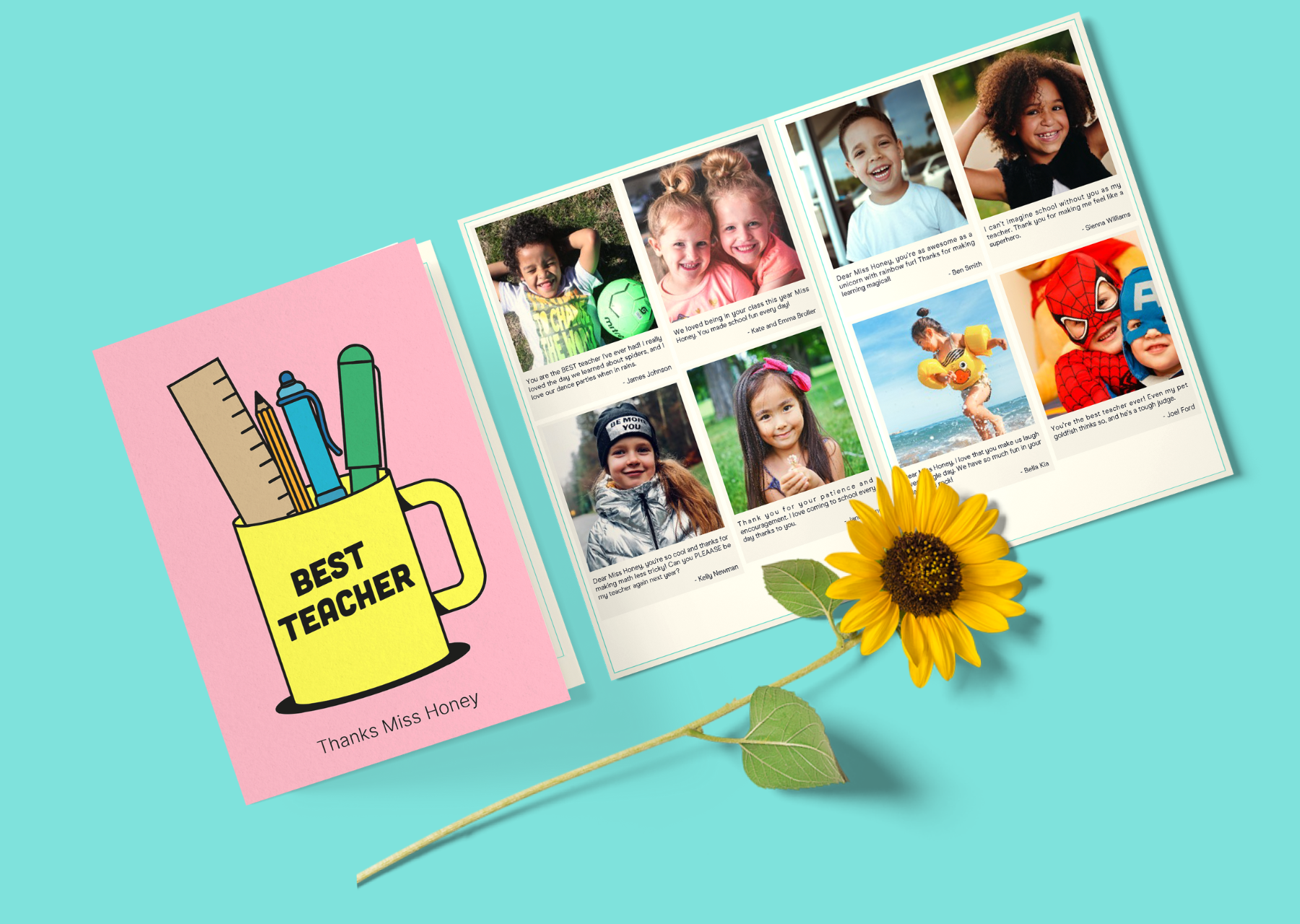
So, you've decided on a group gift, settled on a suggested amount – now comes the part every parent organizer knows: Collecting the money.
Between WhatsApp messages, bank transfers, payment reminders and trying to remember who signed the card, an end-of-year gift can quickly bring out your inner mafia boss.
With GroupTogether, you can set up an online teacher gift collection and group card in one place. Share a single link with the class, let families contribute what they're comfortable with and give everyone the chance to add a personal message – we’ll take care of the fund collection and all the nudges.
Check out our Teacher Guide for your A-Z on all things gifting, plus a quick how-to on Thanking Multiple Teachers.

Melissa Evans
Content Writer

Ali + Julie
Co-Founders, GroupTogether.
Life’s busy. That’s why we’re here to make it easy for you to collect money from a group. Less wasted time, less packaging waste, and spending a little less but giving a lot better!